Home, care, journeys, costs, and glovebox connect the vehicle lifecycle.
AutoMate
Your car, understood as a living machine.
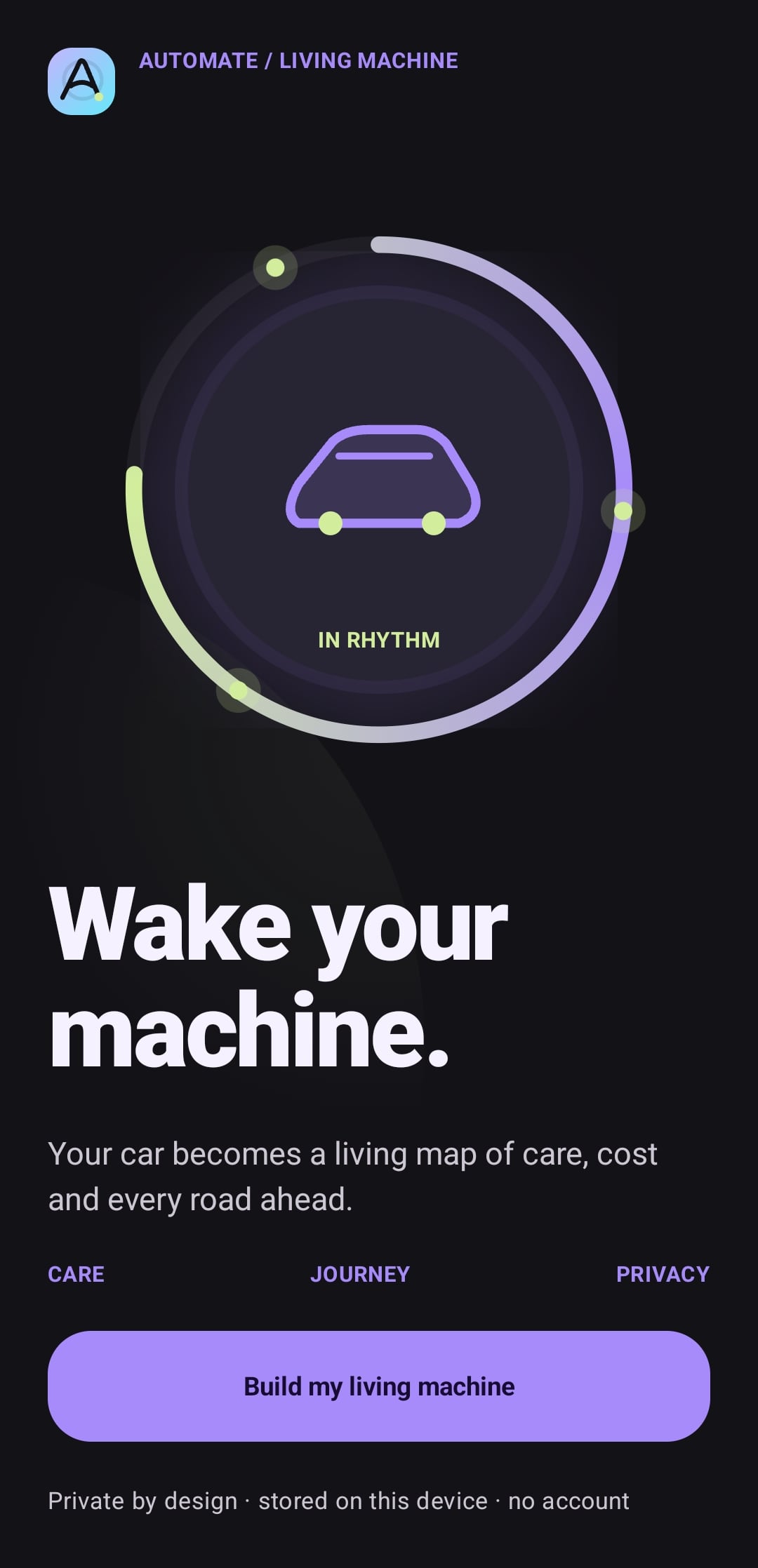
A private, local-first vehicle companion that turns maintenance, mileage, fuel, documents, and costs into one calm living map of the machine.
My roleKotlin developer
Machine atlas01 / 08
Use arrow keys · swipe on touch · tap the screen rail
Machine telemetry
The living system behind every drive.
Audience
Drivers who want a private record of maintenance, mileage, fuel, costs, and vehicle documents.
Delivered scope
Native Android development with Kotlin, Jetpack Compose, MVVM, Room, and Material 3.
Defining constraint
Detailed ownership data must remain understandable and useful without accounts, cloud setup, or a dense utility dashboard.
Care cycles track seven service areas through mileage and history.
Room persistence keeps the working product local-first with no required account.
Verified evidence · All figures come from the implemented navigation, tracked systems, and local persistence model.
Turn ownership noise into one calm machine.
Vehicle ownership scatters essential information across odometer notes, invoices, reminders, fuel receipts, and document folders. The product needed to connect all of it without feeling like another dense dashboard or requiring an account.
Design and engineer the entire ownership rhythm.
Kotlin developer
03 / Machine logic
Choices that make the car feel understood.
- 01
Built the experience around one living machine whose condition changes with every drive and service event.
- 02
Connected care cycles, fuel entries, costs, documents, and mileage instead of presenting isolated utilities.
- 03
Used progressive disclosure and a five-room navigation model to keep detailed ownership data approachable.
- 04
Made privacy structural: local Room persistence, no account, and explicit device-owned data controls.
System architecture
A native app organised like a living machine.
Compose components expose detail progressively while the MVVM and Room layers keep state predictable.
Observe
Mileage, health, and upcoming care compress the vehicle state into one glance.
Remember
Services, fuel, costs, and documents create a continuous local ownership record.
Respond
Lifecycle cues and reminders turn stored information into the next useful action.
04 / Care cycle · SDLC
Observe, remember, care, repeat.
Map the machine
Turned care, mileage, fuel, costs, documents, and settings into one connected ownership model.
Give it a pulse
Created the living-machine orbit and calm status language so health is understood before numbers are read.
Engineer the memory
Used Kotlin, Compose, MVVM, and Room to keep state structured, responsive, and private on the device.
Tune the experience
Designed adaptive themes, quiet motion, reminders, and progressive detail for comfortable repeated use.
05 / In rhythm
A native Android product with a distinctive living-machine identity, calm daily status, vehicle switching, lifecycle-aware care, cost perspective, a private glovebox, and adaptive appearance and motion controls.
Next validationThe next engineering step is adding import, export, and encrypted backup without weakening the local-first model.KotlinJetpack ComposeMVVMRoomMaterial 3